Former Marine Pilot Builds Restaurant Group On Principals Of Hard Work and Generosity to Employees and Community
By Brigid Mander
photo by John Slaughter Imagery
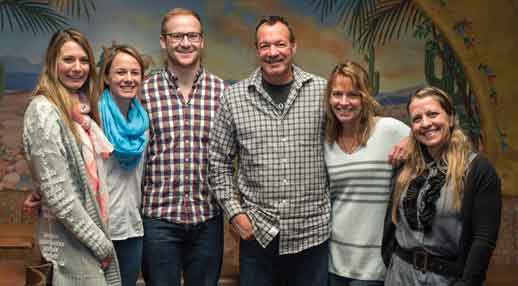
While Jackson Hole may not be the easiest place to start a business, those with determination and a willingness to work hard can make it happen. There are plenty of local success stories. Most are out of the public eye, but others are prominent, such as in the case of Joe Rice, founder of the Blue Collar Restaurant Group. Like so many current residents, Joe Rice visited Jackson once to ski, and thought he liked the place a lot. So in 1989, Joe and his wife Denise moved here, and bought a simple taco stand named The Merry Piglets. They manned it slavishly themselves those first few years, setting themselves on a road to success. Today they see the sum of all the talented people they have been able to hire – and keep on board – as the key to that success. In recognition of that, they are taking those successes and giving back to their employees and to the community at large.
This story of accomplishment and being in a position to improve other’s lives wasn’t in the cards for a guy like Joe Rice. He grew up poor in New Jersey. His father died while he was still in school. But Rice wasn’t the type of kid to accept the fate laid out for him – and he didn’t.
Gifted with academic smarts, athletic talent,and a driven personality, Rice was awarded a track scholarship to Princeton University. After graduation, challenge and excitement beckoned, so Rice joined the Marine Corps to become a pilot. “I always wanted to learn to fly, and I felt that doing it in the Marines would be the biggest challenge,” said Rice. “When you go in the Marines, they try to get you to quit. You have to really want to be there. I learned hard work growing up. I’ve always been this way – to challenge myself and be around the best people.”
Rice spent seven years as a pilot in the Marines, followed by three in the Reserves. “I came up to Jackson to ski once – I had a friend in the Marines who kept telling me check it out – and I really liked it.” Once Rice and Denise arrived, they saw opportunity in the Merry Piglets taco stand – a business that no one else wanted.
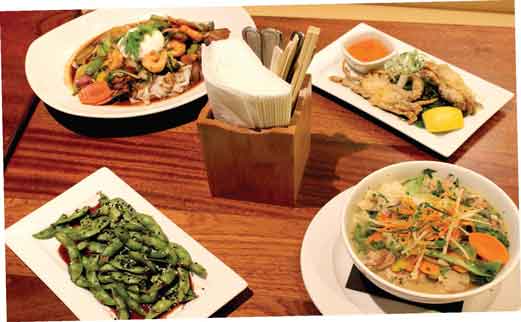
They built Merry Piglets into a full-fledged Mexican restaurant, and since then, Blue Collar has gone on to run a number of eateries, including Sidewinders, Noodle Kitchen, Artisan Pizza, Bubba’s and Liberty Burger.
That might seem like plenty of work in itself, but former-Marine Rice is not one to relax. Since he has come to call Jackson home, he felt a few things were missing from the community. So Rice has undertaken two new projects. One is to build a 25,000 square foot indoor athletic facility for youth and adults, as well as breaking ground on an 80-90 unit apartment complex to help mitigate the costs and stress for Blue Collar employees of Jackson’s increasingly scarce housing.
Rice is a tough guy to compliment. He shrugs off accolades, and passes them on to his team, citing values he learned before arriving in Jackson. “I owe my success to being in the Marines,” he said. “It just sets you up for a certain way of doing things. Take care of your people Lead by example. If something needs to be done, do it yourself. [At Blue Collar] if somebody needs something, we help them.”
Rice credits the success of Blue Collar to this code, and to the type of employee it attracts. “We have had people working with us for over 20 years – everyone is treated as an equal,” said Rice. “They know they can and should give constructive criticism and speak up. Some of the best ideas have come from our staff. Our people really take care of each other. If you don’t have good people, you don’t have anything.”
“[Rice] is invested in everyone’s welfare – and everyone knows it, said Tracey Joralemon, manager of Merry Piglets, who has worked with Rice and Blue Collar for 20 years. “He is invested in the community and the new generation. He came from the working class and he doesn’t forget it.”
“You don’t even know [Joe and Denise] are the owners,” said Megan Watson, a server who has worked at Rice wants to bring opportunities into the community for other local athletes.
“I have three daughters, and I always told them they could do anything they want. Just because you come from Jackson Hole doesn’t mean you can’t go to the best schools and pursue your sports.”
The facility will have a 100×200 meter indoor field for soccer and lacrosse, as well as strength training, stretching, and agility training rooms. “My passion is helping kids, but we will have adult leagues too. And anyone coming to Jackson with nothing, Rice and his wife found the perfect place to build careers, raise a family, and to give back to a place that might be a globally known destination, but that still maintains its small town western American values.
“I always wanted to live in a place where my kids could live in an outdoors environment. Growing up here gave them some really good values. People might have different political views, and this and that, but at the end of the day people help each other.”
Condominium Hotel Properties Show Growth In Value & Income Generation
By Andrew Cornish
Condominiums have long been a way to provide Teton County market participants an opportunity to own property without the responsibilities associated with detached, single-family homes.
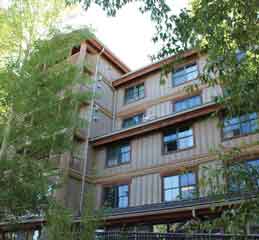
In 2001, the condominium concept was expanded for the Teton Village market with the advent of the first condominium hotel (condo-tel) property. The condo-tel form of ownership combines the attributes of income from a hostelry front desk with lifestyle benefits such as ski storage services, discounted dining and the prospect of being greeted by name as you check into real estate which you own. Add to these benefits the recent trends of increasing income and unit appreciation, and it is no wonder condo-tels have become an attractive form of property ownership to many.
Admittedly, condominium hotel ownership may not be for everyone, as property access typically closes for a brief period during the shoulder seasons to allow for cleaning and owners may be financially incentivized to make their units available for rental for a minimum number of days each season. However, to many, these points are less significant than the potential for income generation and property appreciation.
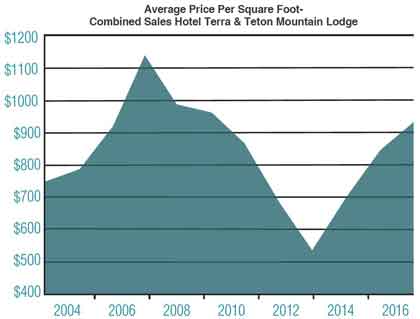
Notably, since the stabilization of the market post recession, owners of condo-tel units have received both increased income and property value. Observing sales from Hotel Terra and Teton Mountain Lodge properties, it is noted that the 2015 average sale price per square foot of these units is over 73% greater than their 2012 post-recession low. While review of the data underlying this measure indicates that a small sample size and the recent prevalence of larger upper-floor units has contributed to this growth being an overly-optimistic gauge, the indication of a return to vibrancy for this section of the Teton Village housing market is solid by any measure. Not surprisingly, a positive relationship between value and rental income level is noted when observing that the 32% growth in price per square foot of this condo-tel sample since 2013 roughly parallels the approximately 29% growth in revenue per available room for Teton County hostelry properties that was reported by the Jackson Hole Chamber of Commerce DestiMetric data for this same period.
Average Price Per Square Foot- Combined Sales Hotel Terra & Teton Mountain Lodge
For information regarding condo-tel and all resort properties, contact the Cornish | Lamppa Realty Group resjh.com/009 or call 307-733-8899
From an early age, Jackson Hole restaurateur, entrepreneur, and co-founder of the Fine Dining Restaurant Group, Gavin Fine, was immersed in the culinary world. Some might say it was his calling.
Chicago & The Passion For Food
Growing up in Chicago in the 1980s and 90s, Gavin was a typical kid. What wasn’t so typical, though, was his penchant for food and cooking, two things that surrounded him throughout his childhood in the city and engrained at home by his parents – mainly his mom.
“When I was eight or nine years old, my mom took me to ‘Mommy & Me’ cooking classes and I was the only boy there. It wasn’t cool for guys back then to be a cook and in the kitchen like it is today, ” says Gavin. “As I got older and a teenager, I was a six-foot dude who couldn’t dunk. I knew I wasn’t going to play basketball, so the whole restaurant thing seemed very interesting.”
At the core of Gavin’s adolescence was a strong sense of family. Gavin’s dad, Dan, grew up in Farmingdale, N.Y. on Long Island and was a rep for an electronics company. His mom, Bonnie, was from Queens, N.Y., and was a talented cook. Family meals were very important, as were chores. And, when their busy schedules didn’t allow for a family sit-down at home, the Fine family dined out – at places like Chicago’s Athenian Room, where Gavin fondly remembers spending hundreds of days as a kid, where“they had the best roast chicken, fries, and gyros hands down.”
The travels and vacations the family went on were added cultural and culinary experiences that helped shape and sharpen Gavin’s interest, love, and intimacy with the food world. On trips, Bonnie made her boys keep a journal, and every one of Gavin’s entries was, yes, about food.
“I could tell you about the best fries in Washington, D.C., or the best burger here, or such and such wherever we were – I liked to eat a lot,” he says.”
With a sturdy foundation for food set, it wasn’t until Gavin met and worked for another Chicago idol of his Richard Melman – the owner of “Lettuce Entertain You” – before college that transformed his life and widened his view into the restaurant business. A restaurant group pioneer, Melman’s innovation, a fusion of food and humor, have remained with Gavin to this day.
Jackson & The Search For The Food Experience
After graduating from Cornell’s Hotel and Restaurant Management School in 1996 Gavin felt the draw of the mountains, fresh air, and less crowds and moved west to Jackson.
Coincidently, one of Gavin’s good friends from growing up in Chicago – Ethan Steinberg – moved out to Jackson that same summer and the two reconnected and lived together for five-plus years.
As many do in Jackson to make ends meet, Gavin worked a few jobs, but during his first four years he was firmly planted at one of the valley’s popular fine dining establishments, the Snake River Grill. Gavin eventfully worked almost every position there. The experience proved to be invaluable, and he met his future business partner, Roger Freedman there.
The itch to learn and experience more led Gavin out of Jackson and into the centuries-old culinary hot spots of Italy and France. Abroad, he absorbed the rich methods, history, and culture of food and drink working at prestigious wineries and vineyards – and there he was first exposed to the European Bistro culture that inspired ideas he would bring back to Jackson.
Furthering his research of Bistros, Gavin toured New York City’s famous haunts – like Balthazar in SoHo – that helped launch the Bistro culture in the U.S. Gavin’s wheels were now spinning with concepts of what the Jackson dining scene was missing.
With the late-90s economic boom, there was a void in the restaurant scene in Jackson between high-end cuisine and fast food – and Gavin wanted to change that. On July 17, 2001, he opened his first of six restaurants with the classic Rendezvous Bistro.
“Everything was under $20 on the menu, and we had 100 wines under $30. We were amazingly successful right off the bat,” says Gavin. “The goal was to take the intimidation factor away for younger people going out and offer great food and a great experience Billionairs were mixed with ski bums. Everyone got the same service.”
Putting The Fine In Dining
With the success of the “Bistro” running high, a few years later Gavin and Freedman started the Fine Dining Restaurant Group.
“Steinberg came up with the name, and at first it was a joke, but it just stuck and it works,” jokes Gavin.
Seeing opportunity to fill a needed gap in the Jackson dining experience, Gavin and Freedman established a variety of restaurants and a catering company in the valley that all serve their own unique purpose and culinary focus – Q Roadhouse (2006), Bistro Catering, Il Villaggio Osteria (2008), The Kitchen (2011), Bin22 (2013), and Bodega (2015). The family of restaurants serve are a cornerstone in the Jackson community, and, despite each location possessing its special vibe, one mainstay holds true: you’ll be treated like family.
“We have core standards that translate across every restaurant, and we want our personality to come out. We approach what we do as welcoming people into our home, and that’s how we teach it. When we open the doors, we hope people feel that warmth and want to come back – that’s an uncompromising theme here,” says Gavin.
In 2013, Gavin was awarded the Teton Board of Realtors’ Business Person of the Year. With roots growing deeper in the valley each year, Gavin’s young days at ‘Mommy & Me,’ his global travels in pursuit of culinary enrichment, and an unwavering entrepreneurial mindset, have helped shape him as a person and create dining experiences in Jackson that wouldn’t have existed without his – and his colleagues’ – visions.
“I’m constantly trying to look at what the needs are here in the valley from a dining and culinary experience.” says Gavin. “I’m super proud of the people and restaurants in the valley here doing an amazing job.”
No Slowing Down
This year, the Bistro celebrates its 15-year anniversary – a milestone for any restaurant. And, Gavin’s a family man now too, with wife Lea, and two boys Bode (7), and Jake (5).
Perfecting the work-life balance is an art – and the successful restaurateur seems to have mastered that – but there’s no sign of slowing down. Gavin and his team are currently constructing a 10,000-square-foot facility that will house Roadhouse beer brewing, Cream + Sugar artisan ice cream, and The Blind Butcher – slated to be the state’s first USDA plant where all meat is sourced locally and regionally. All will be distributed nationally starting in 2017.
“Balancing your life is key, and if you’re out of balance, well, you’re out of balance,” says Gavin. “I love challenges and I really try and connect with every employee and customer the same way I did 15 years ago. The Jackson food scene has come a remarkably long way, and I’m just excited to be a part of it.”
Many people who visit Jackson Hole fall in love with the spectacular scenery and wildlife that the Valley has to offer. When they find out that Wyoming is an extremely tax friendly state, with no individual or corporate income tax, no estate or gift tax, and a relatively low property tax, serious thoughts of settling down in Jackson Hole arise. Because Wyoming does not have an income tax, the Wyoming Department of Revenue does not have a formal definition of residency for tax purposes. Residency is often determined through other administrative agencies, such as Wyoming Game and Fish for the purpose of issuing hunting or fishing licenses. Therefore, establishing residency in Wyoming is easy. Where the challenge arises is in breaking ties with the state where you currently reside.
Trying to move from New York to Jackson to escape high taxes? The New York Department of Taxation and Finance will inform you that your domicile there won’t change until you can demonstrate that you have abandoned it. You can only have one domicile at a time. Domicile in New York is defined as the place where you intend to have a permanent home; where your permanent home is located; the place you intend to return to after being away (as on vacation, business assignments, educational leave or military assignment). New York considers you a resident if your domicile is New York or your domicile is not New York, but you maintain a residence there (whether you own it or not) for more than 11 months of the year and you spend 184 days or more in New York during the tax year. Those 184 days can add up quickly, as partial days count toward that total. Additionally, keep in mind that spending the night in New York counts as 2 days.
Want to get away from California’s burdensome tax system? The California Franchise Tax Board considers residency as primarily a question of fact determined by examining all of the circumstances of your particular situation. They will look at such factors as: the amount of time you spend in California versus outside of California, the location of your spouse and children, the state that issued your driver’s license, where your vehicles are registered, where you maintain professional licenses, where you’re registered to vote, the location of banks where you have accounts, the origination point of your financial transactions, the location of your doctors, dentists, accountants and attorneys, where you have social ties (place of worship, social or country clubs, etc.), the location of your real property and investments and the permanence of your work assignments in California. Like New York, California is known to be extremely aggressive in pursuing its former residents who have moved to tax friendly states seeking relief.
It can be well worth the effort to move to Wyoming to enjoy its beauty and rugged wilderness and save big money on taxes. Just make sure you take all of the necessary steps to properly cut ties with that high tax state you’re trying to escape or you may end up carrying that tax burden to Wyoming with you.
Kathy Zelazny is an attorney practicing in both St. Helena, CA and Jackson, WY, where she is of counsel with the law firm of Mullikin, Larson and Swift LLC. Ms. Zelazny is a graduate of Duke University Law School and has her Master of Laws Degree (LL.M.) in taxation from New York University.
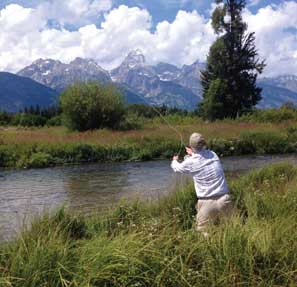
An in-depth look at fine spotted cutthroat fishing in Jackson Hole
By David Riley Bertsch
WE’RE LAUGHING. Cracking up really, because the fishing is just that good. It wasn’t supposed to be like this. It was too early. May-something. The water was too cold and the kind of milky green that only a Steelhead can love. There were no bugs whatsoever. It was our first day of the season floating the Snake River in Grand Teton National Park, and we’d primarily set out to see what had changed during runoff – which channels had closed, which old ones may have re-opened, and where a new deadfall might attract a day-making fish. As for catching, our expectations were low.
You know what they say about the best-laid plans. It was good. Darn good. Like fifty some native fish on big garish dry flies kind-of-good. As we drive back to town, the cathedral group towers to our west soaking up the last rays of sunshine. A mama moose nudges her calf away from the road. I ask myself: Can it get any better?
I was stumped. Still am, in fact.
The Snake River is a gangly serpent indeed. From its origins in Yellowstone, it slithers southwest over ancient bedrock, touting various world-class fisheries along its course: trophy trout on the South Fork, smallmouth bass on the main stem, and finally, near its confluence with the mighty Columbia, steelhead, salmon and the prehistoric sturgeon.
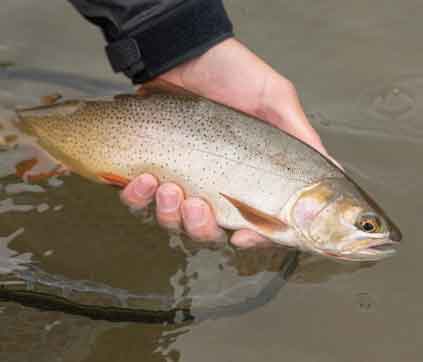
Each of these fisheries stand out in their own right, but perhaps none so virtuously as the Upper Snake in its reaches from Jackson Lake Dam to Palisades Reservoir. Here, a vibrant knickknack of a fish lives on – the Snake River Fine Spotted Cutthroat. According to fossil records, Cutthroat trout have existed in the Snake River drainage for somewhere in the range of 4-5 million years, and thus have endured the perils of an ever changing climate, logging, fur-trapping, gold-mining, industrialization and over-fishing. Still, on an August day with grasshoppers beating their wings amongst the streamside willows and Pale Morning Dun’s dotting the slicks, you might start to wonder if these colorful bantam-weights even noticed we were here.
Michael Paul Photo Works
As a destination fishery, the Upper Snake still gets its fair share of flak. The river is a black sheep among rocky mountain tail waters, compared to engineered eco-systems that fatten and strengthen stocked fish. Below Jackson Lake dam, the Snake fishes as it historically should – like a high mountain freestone river, and all the good and bad that go with it. Fine-Spots are recurrently persecuted for their size — a good one is 15 inches and up — and they’re not always the scrappiest fighters in the world.
But to accurately weigh a Fine-Spot, one must consider all of its attributes. Plentiful? Check. It’s not uncommon for a good angler fishing out of a boat to catch forty-plus fish in a six-hour day. Beautiful? Check. See exhibit A. Surface oriented? Check plus. In one hundred days of fishing the Snake per year, I can basically count the fish I catch subsurface using fingers and toes.
I don’t mean to suggest the Snake River is fool-proof, but armed with the right gear and information, it may very well leave you to wonder, Is there anywhere better.
How
Let’s get one thing out of your head: Snake River Fine-Spotted Cutthroats are not exactly easy to catch. Because reproduction is strong, anyone with a hackled hook between sizes two and twenty-two and a bottle of gink can wade into a calf-deep riffle and tear the yearlings up on the Snake. There’s nothing wrong with that, if you are using barbless hooks. The larger fish, even those just 12” and above, can be somewhat enigmatic, particularly to anglers who are more acquainted with browns and rainbows.
Bigger Cutties are lazy coots for the most part, preferring dawdling currents and deep holes to ripping banks and heavy pocket water. Remember that the Snake is generally cold and well aerated, so its trout aren’t forced into the fastest water. As a result, deep, soft insides and slow banks are moneymakers. A dry-fly cast into what you think is no-man’s land might just get annihilated if you leave it long enough. A large fine-spot needs time to mull over your presentation in slack water, waiting to make sure he’s not being duped. In this situation, it often pays to let the 6 inchers eat and spit out the fly without setting the hook.
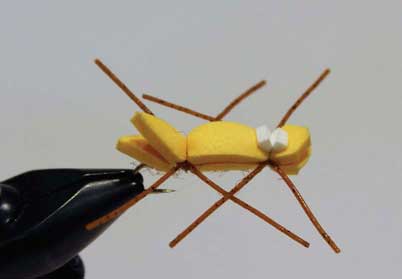
Chernobyl Ant
One exception to the slow water rule is where currents of varying speeds collide in a current seam or fast pour-over. These areas appear raucous from the surface, but thanks to a phenomenon called a hydraulic jump, a calmer swirling flow develops beneath and just downstream of the collision point. Large Cutties love to call these “jumps” home. Chuck a foam hopper into the chaos and hold on.
Perhaps the most rewarding way to catch larger Cutthroats on the Snake is spotting and stalking in skinny side channels. This requires a measure of finesse reminiscent of spring creek brown trout fishing. Leave the foam flies in the boat, and only bring along finer tippets and low-profile mayflies in the #14-18 range. An 18 inch trout will happily live in a channel narrower than your wingspan, especially if there is spring influence or an easy escape route nearby.
Walk carefully upstream, wade only when necessary, and assume a safe casting range is about twenty-five feet. These fish eat slowly and deliberately and you will only have one – maybe two – shots, so make it count. It’s safe to say that a large portion of the trophy fine-spots from the Snake are caught under these circumstances on small dry flies.
On the subject of flies, I rarely fish anything that isn’t foam or a parachute-style mayfly. Sure, there are exceptions, and we all have our favorite secret flies for picky fish (ahem, small Formica imitations), but for the most part a Chubby Chernobyl style Ant between size 6 and 14 and a selection of smaller parachutes in various tones will do the trick.
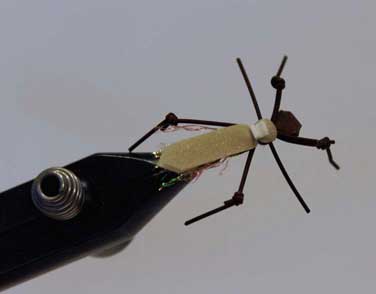
For foam flies, I much prefer those with a dubbing body than segmented foam body types. The untidy fibers furnish a buggy look that segmented foam lacks. Purple, red, pink and gold are my favorite colors, and the patterns I use almost always include some element of sparkle in the dubbing and tail. UV dubbing never hurts. A high-vis antron wing is helpful for the some fisherman, but there are times when I find a lower sitting fly to be more effective. Variations on the Chubby Chernobyl like Will Dornan’s Water Walker and Circus Peanut can outperform the basics on tough days. I usually fish these flies on the small side — #10, #12 or even #14 if I can find them, especially later in the season.
Will Dornan’s Water Walker
At times when I find an even smaller fly necessary, my go-to is a Borcher’s Parachute Moose Tail. This fly is essentially a Parachute Adams, but with a darker tail of moose hair, a segmented body and a more fibrous dubbing that lends a buggy, disheveled look. From sizes 10-20, it can reasonably imitate any hatch on the river.
If things really need fine-tuned, I’ll fish a Tilt-Wing Pale Morning Dun, or a Brooks Sprout Emerger to imitate the plentiful Mahogany Duns. Both of these parachute-style flies float well and are reasonably visible.
The most important thing on the Snake is to not overthink your fly choice. Try foam in likely water and if you aren’t satisfied, go with the Moose Tail. If you see sippers and/or keep getting refusals, tie on a more specific mayfly pattern.
As for rods, all you need is your 9-foot five weight. A fast action blank helps in the afternoon wind. A nine-foot 3x leader with tippets from 3x to 5x will cover your dry-fly needs — Snake River Cutthroat are not generally tippet shy. Focus instead on your presentation.
When
Weather in Jackson Hole is extremely volatile from Early October to Late June. This is not to say that fishing can’t be outstanding during that time, just that if you are traveling from afar, you could lose valuable fishing time to inclement weather. The safest months as far as weather and water clarity are August and September. July can be outstanding, but if the Tetons receive above average snowfall, the water may still be high and milky green due to snowmelt. Call a local fly-shop before you come to check the conditions. October can be similarly spectacular, but beware of weather and the fact that the Jackson Lake dam’s flows will dwindle at some point during the month, displacing fish and making for at least a few challenging days.
Instead of changing with specific insect hatches, I find the Snake River to vary in general moods. For instance, as soon as the river clears, I will often fish a foam fly in sizes 6-10. As the summer wears on I downsize my foam selections until sometime in mid-August, when I almost always start with a parachute Moosetail, size 14. There are days in early September where I will begin with a Brooks Sprout emerger or a Tilt Wing Dun and go from there.
Most years, the Snake’s Cutties will go back on foam sometime in mid-September as their metabolism increases with the oncoming winter, but this isn’t always the case. If this occurs, I find my best success using flies like the Water-Walker that give the fish a fresh look at foam.
Where
The Snake River can be floated in a drift boat from the Jackson Lake Dam to West Table Boat ramp, south of the Town of Jackson. If you aren’t an experienced rower, a good guide is important – deadfalls and fast current lead to accidents every summer in Grand Teton national Park. Below South Park Bridge, the river slows considerably and is best-fished early and late season when water temperatures make the fish sluggish, or when cloud cover ignites a mayfly hatch.
The most popular fishing sections are the four between Pacific Creek and South Park Bridge, where side channels and plenty of bankside structure offer prime habitat. When runoff blows out the river, the short section between Jackson Lake Dam and Pacific Creek can offer clear water and rising fish.
Pacific Creek to Deadman’s Bar
Starting at Pacific Creek boat launch just inside the Grand Teton National Park Moran Entrance, the Snake is characterized by relatively lazy currents and a single, main channel as it flows south towards Deadman’s bar.. Here, look for fish on messy deadfalls and grassy banks. A mile after the put-in, the river begins to braid. Many of these first channels are too skinny to navigate in a drift boat, but anchoring and wading can be productive. The river then pours again into a single channel, where high gravel “hopper” banks hold good numbers of average sized cutthroats. When boat pressure is high, any medium sized tungsten beaded-nymph 16 inches under a foam dry will pass the time between rising fish against these high walls.
This section, between Pacific Creek and Deadman’s Bar, is over ten miles, so don’t dawdle. The last half of this section features a brisker current, various braids, and several tributaries. This is mayfly country from mid-July until the first freeze. Often, a size #14 or #16 Moose Tail is all you need.
Deadman’s Bar to Moose
The float between Deadman’s Bar and Moose junction is a personal favorite. It is short and fast, but complimented by tributaries, sloughs, spring creeks and riffles. When I fish this section, I expect to spend at least a couple of hours out of the boat, looking for mayfly eaters in calm sloughs and pitching foam flies into crashing hydraulics. In the main channel, almost every bank will produce with a Chubby Chernobyl trailed by a #14 or #16 parachute.
Halfway through the section, the river braids into what locals call “the maze” and really begins to pick up steam, which it will carry almost the entire way to South Park Bridge downstream from the town of Jackson. Many side channels are too shallow or tight to navigate. If you stay in the main stem and follow the boat traffic, you can always anchor and walk back upstream to a good-looking hole. A big trout is not worth your life.
Moose to Wilson Bridge
The lengthy stretch between Moose Junction and Wilson Bridge is your best bet to catch great numbers of large Fine-spots. These thirteen miles of the Snake run through a myriad of side channels, riffles and ebullient banks. Again, a foam fly trailed by a more imitative dry is the go-to. The river here, can be dangerously swift, so be sure to read the water carefully. For whatever it’s worth, The Jackson Hole One Fly tournament is almost always won on this section.
Below Wilson, the river continues at a brisk pace until the take-out at the South Park Bridge. There is no shortage of larger fish here either, but expect them to be choosy as fishing pressure is heavy . Also note that in recent years, landowners in this stretch have seen an increase in trespassing and are less forgiving of wayward fisherman. If you need to anchor and get out, please do so on an island across the channel from a rock-levee wall. The regulations on exiting the boat between Wilson and South Park are currently evolving, but anchoring on a mid-river island between levee walls is legitimate as of this writing. If a landowner disagrees, apologize and pull anchor quickly so as to avoid stricter regulation in this high-use area.
The sections downstream from town: South Park to Astoria and Astoria to West Table feature slow, long pools punctuated by river-wide riffles. Fish the banks and the broken water with a Chernobyl style ant or a Parachute Moosetail. When there is cloud cover, Baetis, PMD’s and Mahogany duns can hatch in great numbers.
It is possible to float and fish the whitewater section of the Snake River Canyon from West Table to Sheep Gulch, but only with an accomplished oarsmen who is familiar with the river.
Wade fishing is best in Grand Teton National park, where all land is public and boat ramps and other access points provide plenty of opportunity.
Some of my favorite walk-in spots include Blacktail Ponds, just north of Moose Junction, and River Road, which departs off of the interior park road between the Taggart Lake trailhead and the Climber’s Ranch. Both of these access points feature various spring creeks and tributaries as well, but be aware that seasonal regulations differ between the Snake and its tributaries to protect spawning trout. Always check the regulations before you go.
Downstream from the National Park, wading is best near the Wilson Bridge on Highway 22. Two public levees provide access here. In combination, these walking paths provide four miles of good bank access. At summer flows, the Snake in this section is eminently wade-able. On the East side especially, the river is sinewy and diverse. Side channels and confluences provide endless holding water.
Further downstream, walking in is easiest via the boat launches: South Park, Pritchard, Elbow and East Table. West Table launch provides decent access, but the area is overrun with launching white-water rafts during the high season.
Surrounding Waters
Jackson Hole is Shangri La for the dry fly fisherman. In addition to the Snake River, there are countless streams and lakes brimming with native fish in every direction. Most of the better water is easily accessible. For starters, try the Gros Ventre or Hoback Rivers and their tributaries. Both of these smaller rivers have excellent park-and-wade access from the roads that follow their course. The same flies and techniques used on the Snake are effective. The Hoback even boasts a Salmonfly hatch in early July. Blacktail Ponds and Flat Creek offer sight fishing to large Cutties, but be aware of seasonal closures.
If you’re feeling more adventurous, pitch a tent high up on the Gros Ventre road and explore its many tributaries. The highlights include Fish Creek, Cottonwood Creek and Crystal Creek.
In Grand Teton National Park, try Pacific Creek and the Buffalo Fork.
When You Go
Jackson Hole is an enormous tourist draw. There are endless lodging options. Stay in town if you want restaurants and watering holes.
Grand Teton National Park hosts comfortable, facilities, and the location is prime for fishing the snake. For more primitive camping, Gros Ventre road has various pull-offs and established campgrounds. Always be aware of bears and store your food accordingly.
There are a dozen or more outfitters in and around the town of Jackson that offer guided fishing on the Snake River.
When you book, make sure the outfitter has permits to fish all the best water. It’s always smart to explain your expectations and experience level to the outfitter before you arrive.
David Riley Bertsch is a fly-fishing guide and writer in Jackson Hole. He has published two fiction novels, “Death Canyon,” Scribner, 2013 and its follow-up, “River of No Return,” Scribner, 2015.
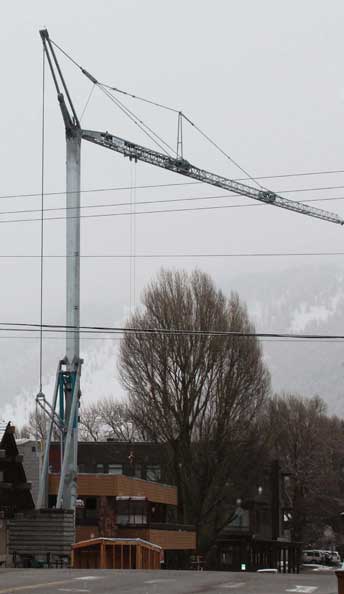
A look around the Town and County shows commercial construction is underway again in Teton County – cranes indicating that some of these are larger projects. However, the construction of larger buildings may become increasingly difficult as only a few lots remain with entitlements for the Planned Mix Use Development provision of Jackson’s Land Development Regulations – a provision that was recently removed as an option for future developments. Below is a summary of some of projects that have been ongoing in Jackson Hole:
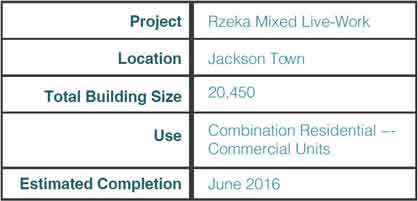
Rzeka Mixed Live-Work
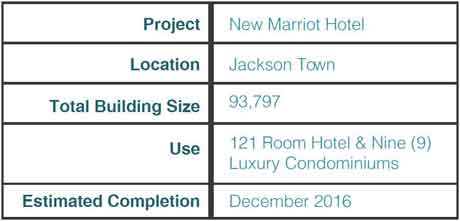
A New Marriott Hotel
A New Marriott Hotel is located on Simpson Avenue just west of the Community Center for the Arts. The development was originally approved in 2002 as part of an 18-lot master plan for 289,471 square feet of building area which used the now-eliminated Planned Mix-Use Development Option (PMUD) of the Jackson Land Development Regulations. The six-lot site totaling 45,000 square feet was purchased by the current developer in December of 2014. Without the PMUD, the maximum density of development would have been a Floor Area Ratio (FAR) of 1.30. This would have yielded a maximum building size of 58,500 square feet (45,000 x 1.3). However, the PMUD entitlement has allowed for the construction of 93,797 square feet of building area in this location, with 73,000 square feet of this area being dedicated to 121 guest rooms and over 16,000 square feet being dedicated to nine for-sale, top-floor luxury condominiums. All totaled, this building equates to an FAR of over 2.05 on a six-lot site.
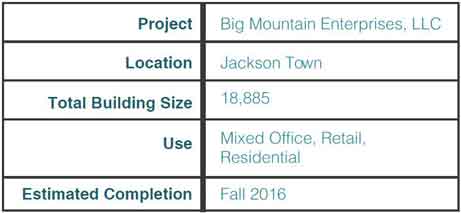
A New Office and Retail Building
A New Office and Retail Building is being built at 115 E. Pearl Avenue, across the street and to the west of the Jackson Town Hall. This development continues the trend noted in the Marriott construction of developers taking advantage of expiring PMUD entitlements. This 7,500 square foot lot was developed to a Floor Area Ratio (FAR) of 1.89 when including the affordable housing requirement, a figure significantly greater than the now-allowed 1.3 FAR. When completed in the fall of 2016, this building will total 13,725 square feet of above-grade area allocated between retail and office uses on the first two floors and residential units on the third floor. An additional 5,130 of below grade area will be dedicated for a fitness area and storage use. The market residential units are designed to be between 1,100 and 1,500 square feet, with a deed-restricted employee unit of less than 500 square feet. All of these units are being leased rather than sold initially. The owner / developer plans to lease the commercial space in the property at annual lease rates of between $40 (ground floor retail) and $32 per square foot (NNN).
New Office on Pearl Ave.
A 15-Unit Work-Live Development
A 15-Unit Work-Live Development is being built at 1200 S. Highway 89 east of S. Hwy 89 and west of the Hidden Ranch Subdivision. A work-live development has both commercial and residential space, but can only be resided in by the occupant of the commercial space (cannot be leased to separate residential and commercial tenants). The site of this development has a gross acreage of 44,135 square feet with some loss of usable area to Flat Creek. Through the interpretation of the residential area as being targeted as workforce housing, a total allowed building area to 20,450 was constructed on this site. The units range in size between 1,120 and 2,000 square feet, with the range of 1,120 to 1,540 being most prevalent. An interview with a source representing the development indicated that a price of $500 per square foot would be targeted.
The Caldera House Lodging and Club Facility
The Caldera House Lodging and Club Facility is being built in Teton Village next to the Tram Dock at the Jackson Hole Mountain Resort. Development in Teton Village is unique in that, in addition to the more typical dimensional limitations of floor area ratio, height and setbacks, Teton Village commercial lots are additionally governed by a master plan that has provided each commercial lot with a dedicated amount of lodging and commercial use.
The Caldera House site had been allocated 74 lodging APO’s and 13,359 square feet of commercial area which allowed for the construction of a 53,228 square foot building on a 21,344 square foot lot (Teton Village FAR’s are the highest in Teton County allowing for a building that is 2.5 times the lot square footage). The Caldera House was designed as an upscale dining and ski club facility, with amenities including a state-of-the-art locker room, valet parking and concierge service, high-end spa facilities, and a private après-ski lounge. Joining the club will cost $100,000. The building will also be allocated into eight private residences ranging in size between 1,500 and 5,000 square feet that will be available as rentals, as well as restaurant and retail space that will be open to the public.
Summer Provides Endless Opportunities for Recreation in the Tetons
By Brigid Mander
Since the winter of 1966, skiers of a certain type – usually those with a particular penchant for an adrenaline rush – flock to western Wyoming to ski the famed steeps of Jackson Hole Mountain Resort. In the summer, overall tourism numbers increase greatly when nearly three million people pass through Jackson, with visitors from all over the world on their way to see the jagged peaks of Grand Teton National Park and the natural wonders of Yellowstone. In the past, it was usually without a second thought for the mountain access the ski area offered.
Over the last ten years, however, that has changed drastically. Although the ski area was born through a 1963 special use permit from the U.S. Forest Service for a resort “specializing in skiing on National Forest Lands,” it is now a growing year-round destination. For decades, the base area village of the ski resort was not much more than sleepy mountain meadows in summer, with only a few curious sightseers out for scenic tram rides and hard-core locals running and hiking to the summit for a workout. Most businesses were closed for the season, and you had to take yourself into the town of Jackson for any kind of social scene, good food, and fun.
Now, thanks to some serious effort on the part of the resort and Teton Village, on any given midsummer day, the village is hopping with a vibrant sports and culture scene for both tourists and full-time residents. Kids jump on a bungee trampoline, people of all ages play on a rock climbing wall and a ropes course (and new this year, a drop tower) while rows of bikes glint on their way up the chairlift to the bike park.
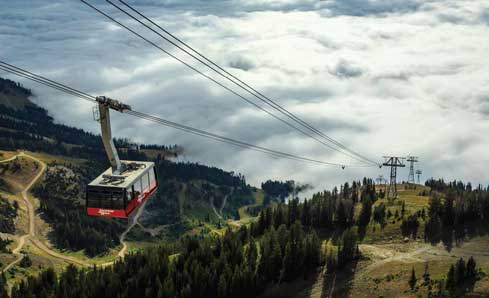
People load the tram for sightseeing and the grab a bite of the famous Corbet’s Cabin waffles (a tradition for visitors and long time residents alike), as well as high altitude hiking and rock climbing. The gondola ferries people up for festive cocktails on The Deck and culinary treats at Couloir restaurant, while on the mountain, hikers, bikers, runners, and Frisbee golf players get after it under a sky often filled with the colorful wings of tandem paragliding flights.
Free concerts on Sunday evenings bring out crowds, as well as the classical Grand Teton Music Festival series, and, because of the increase in people, restaurants in the village now stay open throughout the summer, so people can enjoy choices ranging from Italian to Thai food.
“Teton Village is a hidden gem in the summer. It’s much quieter than town, with nice restaurants open, and all the outdoor sports options – from looking at wildflowers to paragliding – continue to expand,” says Anna Cole, Jackson Hole Mountain Resort spokeswoman. “It’s a great place for locals, families, and it is all super accessible to the mountains. But it still keeps its nice, mellow, vibe.”
The main attraction in summer centers around fun in the mountains. The resort has taken care to make sure people, whether they live here or are visiting, can find their level of adventure all in one spot.
The tram remains the number one attraction, despite the myriad of new options. Summer tram ridership used to hover at under 10% of annual revenue, but now, the access it offers has become so popular that it now comprises over 20% of yearly revenue, according to JHMR spokeswoman Anna Cole.
There are newly built hiking trails around the summit, such as the challenging Cirque trail and Ranger Overlook, on which you can run or hike and enjoy the high alpine environment. The resort is also planning to build a via ferrata, a protected climbing route that will allow visitors the experience of scrambling and climbing over exposed cliff faces and ridges on the upper mountain while clipped into, and fully protected by, bolted cables along the route.
The resort is happy to promote hiking up the 4,139 feet of vertical ascent to the summit – there is no cost for your human-powered ascent. Tram rides back down are free. And, due to new trail building, you can climb the whole length of 6.1 miles of nearly all single track called the Summit Trail. This same route is celebrated each August with the very burly Rendezvous Mountain Hill Climb. This non-profit running race up the trail to the summit, is held in honor of JHMR aerial tram mechanic Chris Onufer, who died in an avalanche in 2012.
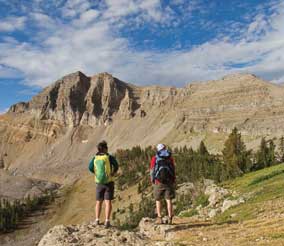
If 4,100 feet of vertical ascent is not your goal, beautiful hiking trails exist across the lower mountain, where you can walk over little mountain streams and through thick fields of colorful wildflowers up to your waist. Another local favorite is to hike or run up to the Deck (at the top of the Bridger Gondola, elevation 9,095 feet) for a bite and some afternoon cocktails, and time with friends in the sun above the valley.
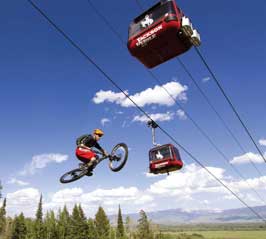
A few less physically strenuous, but more adrenaline oriented-options are also there for the taking: Jackson Hole Mountain Resort is constantly working on improving their lift-accessed bike park, with jumps, wooden ramps and platforms, and smooth, flowy banked trails. The bike park has trail for everyone from beginners to those looking to improve their technical skills, and local riders flock to the park for a break from climbing under their own power, especially on Fridays when the resort offers discounted evening tickets.
The resort offers a Grand Adventure Pass, which is a one day pass to the tram (up-ward bound), the ropes course, a new drop tower, the climbing wall, the gondola, and bike park. Not everything costs money, of course: the popular disc golf course, hiking, cross-country biking, and the kid-favorite pop-jet fountains are all free of charge.
On an even higher adrenaline level, Jackson Hole Paragliding operates daily from the top of the gondola and the top of the tram, taking passengers for an average of 15-minutes flight above the Tetons and the Jackson Hole valley.
“We teach about 15 novice students per year,” said co-owner Scott Harris. “But we do about 2,500 tandem flights a year,” he said, for locals and visitors who want a birds-eye view of their mountain playground. “The village has gotten so much busier – and the music brings out so many people.”
Whether you spent the day playing on the mountain or working at an office in town, summer evenings at the village have become a big draw. While the renowned Grand Teton Music Festival (usually held in Walk Festival Hall) is not free, the Sunday evening shows attract a casual crowd of families and people ready to sit in the grass and listen to music. Before or after the concert, the bars and restaurants at the village offer it all, from buying a six pack and a picnic snack at the General Store to the more refined Four Seasons Bar and restaurants.
The mix of residents, visitors, and the myriad of outdoor sports options in a place that is more hidden from the summer crowds make the village the perfect place for a summer day or evening, and offers a great insight into the community and lifestyle that Jackson Hole represents.
The idea of the Buyer’s Guide is to bring the reader information necessary to make an informed decision. Our hope is that this magazine piques your curiosity and then leads you to the most up-to-the-minute listing data at the Cornish | Lamppa search engine through easily-accessible pre-saved searches. Choosing the price range in which you are shopping along the left margin and following this row through its intersection with the eight submarkets of the Teton Countyreal estate market (listed along the top of the page), it is quickly discernible what neighborhoods are likely to be home to the property you are looking for. It is very important to note in these times of limited inventory this table does not attempt to report currently active listings. However, we could not bear to leave technology completely out of the picture, so feel free to use the abbreviated URLs at the row ends or column headers which access saved searches on the Cornish | Lamppa search engine for your selected price range or chosen submarket area. If active inventory is not in existence for a particular URL, putting the Cornish | Lamppa team to work for you is the best first step you can take to finding your Jackson Hole ideal.
The following chart is general in nature and not a definitive limitation of property attributes or values in these areas.
GTMF Celebrates Ten Years With Director Donald Runnicles
By Brittany Laughlin
Each summer since 1962, the nation’s finest orchestral musicians gather in Jackson Hole to take part in the Grand Teton Music Festival. The seven-week classical music festival presents more than 40 events throughout Jackson Hole with concerts taking place in its acoustically acclaimed concert hall in Teton Village and, in an increasing amount, in the town of Jackson. This year marks the tenth anniversary of world-renowned conductor Donald Runnicles who serves as the Festival’s Music Director. Scottish-born and Berlin-based, Donald embodies the Jackson Hole lifestyle—biking to concerts, hiking with his family, and fitting in pre-rehearsal tennis matches.
Donald Runnicles Photo Credit Michelle McCarron
To celebrate his important milestone, which the Festival has dubbed “Ten Years in the Tetons,” GTMF is offering up a line-up of classical music’s most influential artists, performing engaging repertoire throughout Jackson Hole.
The festivities begin July 4th with the annual Patriotic Pops concert. A community tradition, Maestro Runnicles conducts American favorites for his adopted country. Later in the week, from his homeland, Maestro Runnicles conducts the National Collegiate Chorale of Scotland for a monumental performance of Beethoven’s 9th Symphony with the Festival Orchestra. Maestro Runnicles will also take the stage as pianist in an intimate concert with mezzo-soprano Kelley O’Connor and iconic cellist Lynn Harrell to perform some of his favorite works.
The Festival’s annual gala concert featuring violin superstar Joshua Bell is July 13th. The must-see event of the season, Mr. Bell joins the elite players of the Festival Orchestra under the baton of Maestro Runnicles for a concert including “Summer” from Vivaldi’s Four Seasons among other beloved violin concertos from Saint-Saëns and Argentinian composer Piazzolla. Internationally hailed as one of the most important artists and a frequenter on the world’s most prestigious stages, Joshua Bell is the pinnacle of the 2016 season.
The entire season presents the best and brightest of the classical music world, including cellist Johannes Moser who makes his GTMF debut with performance of Tchaikovsky’s Variations on a Rococo Theme (July 15th & 16th), a piece that earned him the top prize at the Tchaikovsky Competition. Violinist Nicola Benedetti also makes her first appearance as part of a week-long residency. Despite performing three concerts (including one featuring the virtuosic Violin Concerto by the notable Hollywood film composer, Erich Korngold) audiences will be left wanting more.
Nicola Benedetti Photo Credit Simon Fowler
This season, the Festival continues its mission of bringing great music to venues throughout Jackson Hole. In addition to concerts at Walk Festival Hall in Teton Village, the Festival offers Free Family concerts at the Teton County Library, a gallery concert featuring the dynamic violinist Simone Porter at Heather James Fine Art, as well an exciting performance at the Pink Garter Theatre with classical crossover trio Time for Three. The classically trained troupe performs a range of music spanning from Beethoven and Brahms to popular hits from the Beatles, Kanye West, and Justin Timberlake. Only in Jackson Hole can you kick back, sip a cocktail, and listen to a world-class performance in a club.
With $15 Day-Of Rush tickets available for most concerts and free Inside the Music and Family concerts, GTMF’s Ten Years in the Tetons offers world-class entertainment and a display of breath-taking talent at a steal. Join in on the celebration July 4th through August 20th.
In celebration of Music Director Donald Runnicles’ Ten Years in the Tetons, GTMF presents an unprecedented summer line-up that delights at each and every opportunity.
Here are the some of the seasons best must-see moments:
Beethoven’s Symphony No. 9
Friday, July 8th | 8PM
Saturday, July 9th | 6PM
Pianist Jonathan Biss & Beethoven
Wednesday, August 10th | 7PM
Friday, August 12th | 8PM
Saturday, August 13th | 6PM
Gala Concert with Violin
Superstar Joshua Bell
Wednesday, July 13th | 7PM
Classical Crossover Trio
Time for Three
Wednesday, July 20th | 8PM
Masterful Violinist Nicola Benedetti
Thursday, July 21st | 8PM
Friday, July 22nd | 8PM
Saturday, July 23rd | 6PM
Number of Sales Moderate as Prices as
Inventory Remains Tight and Prices Edge Higher
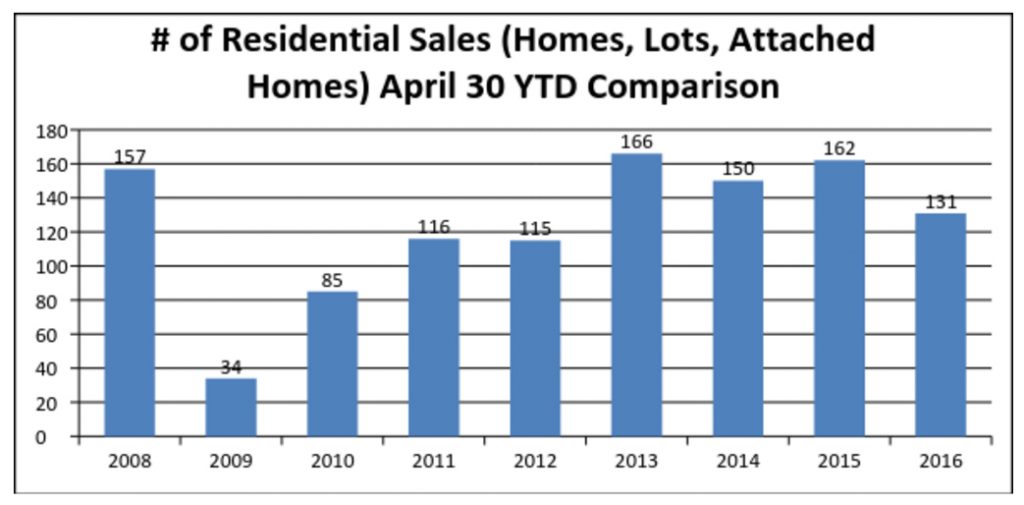
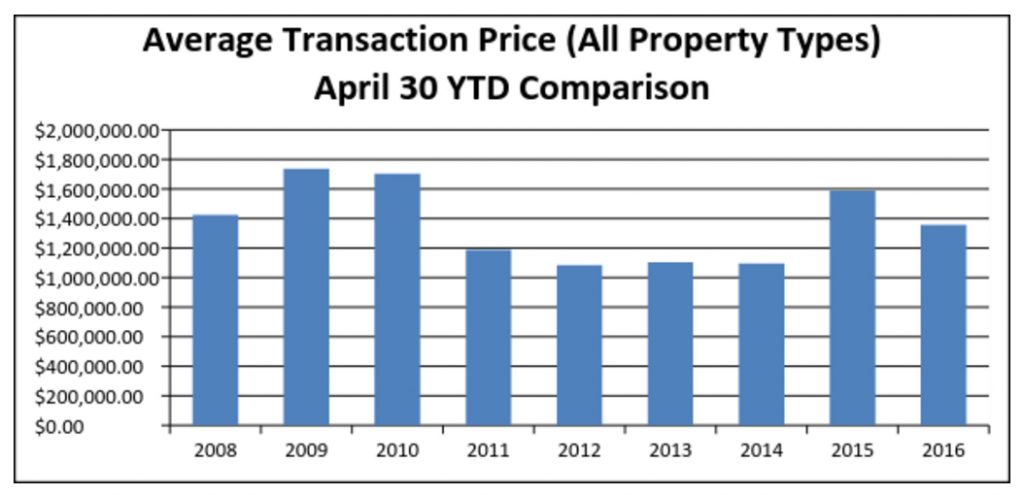
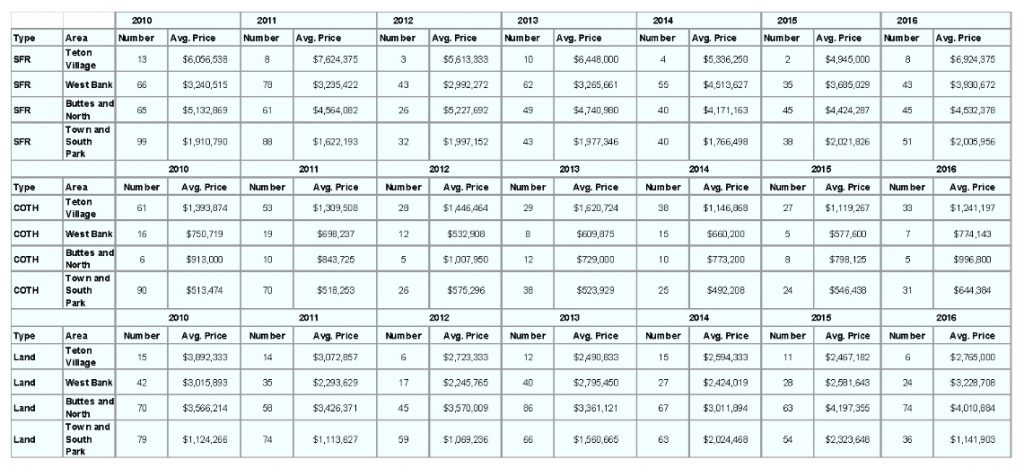
The first four months of 2016 saw a continued increase in the number of single-family home sales, while attached homes (condominiums and townhomes) and vacant homesites sales lessened in number. Real estate pricing in Teton County has continued to generally show upward trending, but at lower rates of appreciation than had been noted in the “rebound period” of 2012-2015. Tightening inventory is the most frequently-identified reason for moderating sales volume, with a corollary of current inventory levels being that sellers feel confident to aspire for price points reflective of continued robust appreciation, with the reticence of buyers providing the indication that a leveling of prices may be the buy-side interpretation of the market (said otherwise… a standoff). After 3-4 years of very strong appreciation, it is intuitive that the rate of price growth will, in fact, moderate. However, continued low inventory levels and sellers that often do not have a motivation to sell within a time constraint may dictate that sales volume numbers remain low while the interaction of these opposing market forces plays out. Notably, while the aggregated data on pricing shows a decrease in the overall average price of real estate, this is simply a result of the small sample size of sales, as the comparison of the sales and resales of similar properties indicates a level-to-still increasing trend.
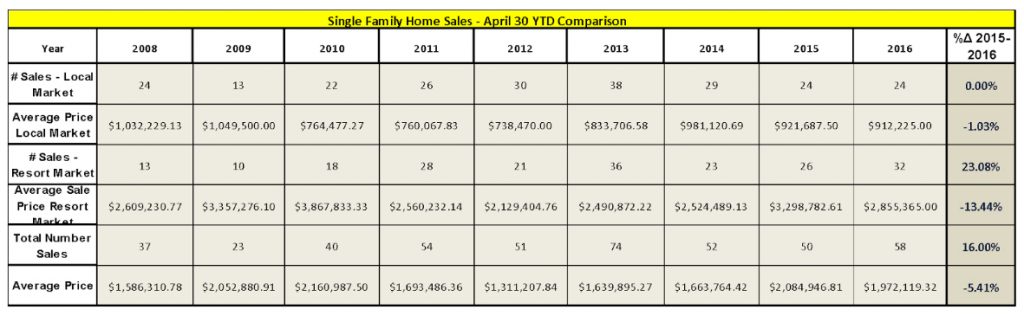
Single-Family Home Sales Trends Through April 2016
The single-family home market segment was the only segment to show continued growth in the number of sales. Average sales prices in this market segment shows a level reporting for the Local Market and a slight drop for the resort market. However, as previously discussed, examination of individual sales reveals a level-to-slightly increasing value trend being currently ongoing, with the aggregated data being skewed by its small sample size.
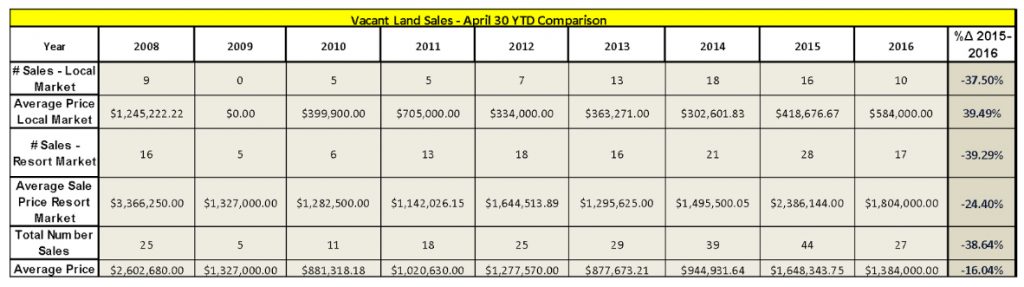
Vacant Land Sales Trends Through April 2016
Vacant land sales decreased in number for both the Local and Resort Market with the decrease in volume being similar in magnitude for both market segments. The average sales price for the local market showed a substantial increase (39.49%). However this measure was atypically influenced upward by two sales in the Gill Addition this spring, an area that arguably may now be more aptly considered as part of second home market. Conversely, the average price of lot sales in the Resort Market was skewed downward by the influence of two sales of two 6,400 sf pads for cluster homes in Teton Pines. Examination of resale data of similar lot provides the indication of a stable-to-slightly-increasing value trend for the both market segments.
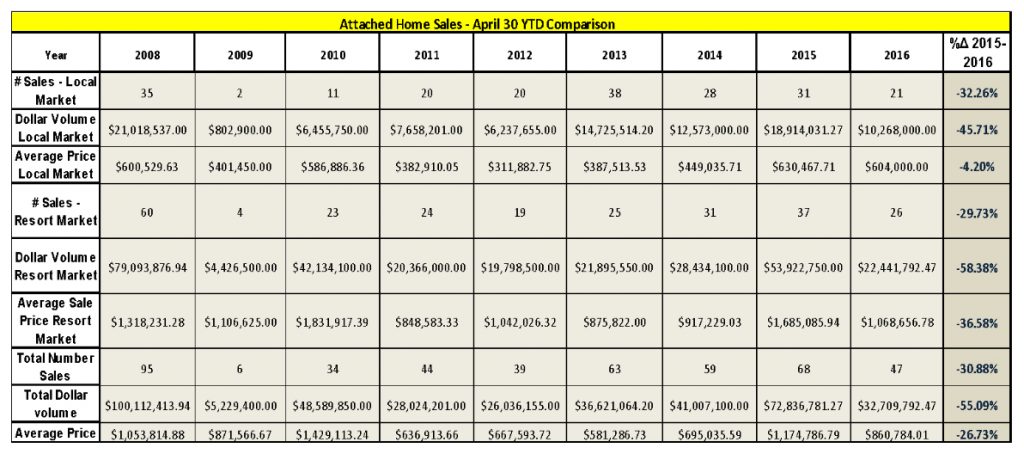
Attached Home Sales Trends Through April 2016
The number of attached home sale was off an average of nearly 31% when considering both the Local and Resort Market. The observed sales indicate a drop in average price, but this is again due to the small sample size in early-year reporting. In particular, the first four months of 2015 saw the sale of five (5) Four Seasons Residences units, while no such units have transacted yet this year. A review of active listing data indicates that only one such unit is currently available for sale, indicating that the lack of sales may be a result of low inventory. Similarly, competition for inventory in the Local Market appears to be ongoing, as two listings in the Cottonwood Flats addition were placed under contract in less than a month of being listed when being price between 3-5% above the previous sales of such units.
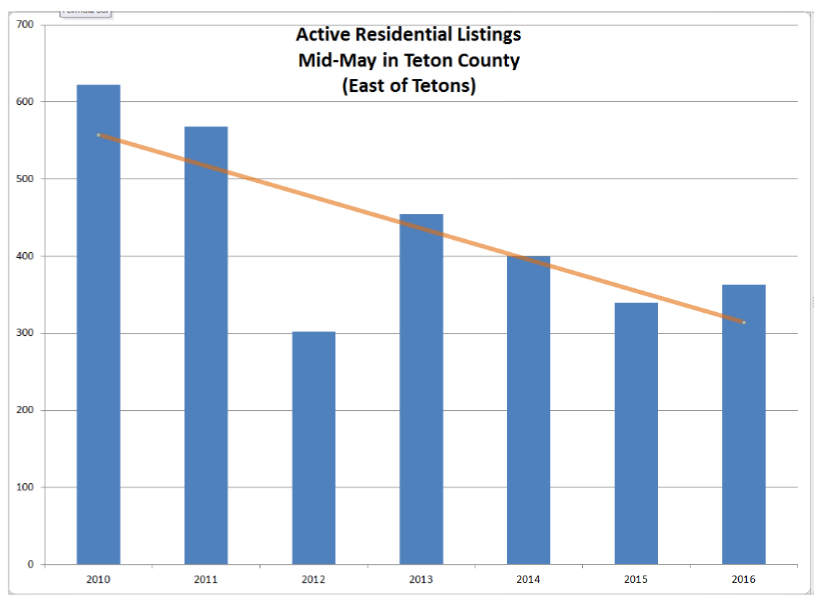
Inventory Levels
The preceding table arrays a mid-May snapshot of inventory levels for the past 7 years. Inventory levels continue to remain low and are frequently cited by agents as a stagnating factor for volume levels. As of mid-May of 2016, the inventory of homes, attached homes, and vacant land listed for sale was showing to be 6% higher than this time last year, but still near post-recession lows.
Andrew Cornish – Broker
PO Box 9467 | 155 E. Pearl,
Suite 10
Jackson, WY 83002
(307) 733.8899
(307) 413.7799 Linkedin
Data provided by Rocky Mountain Appraisals, Teton County’s leading valuation firm: www.rmappraisals.com
Copyright 2021 Cornish Lamppa Realty Group. All rights reserved.